December 2026 Calendar With Moon Phases follows US Eastern Standard Time. The new moon is Tuesday, December 8, and the full moon is Wednesday, December 23. December also includes two last quarters in the Eastern time zone, one on the first day and one on the 30th. If another calendar places the full moon on Christmas Eve, check its time zone. The event falls shortly after midnight on December 24 in Universal Time and during the previous evening on the US East Coast.
December 2026 Calendar With Moon Phases: Free Printable
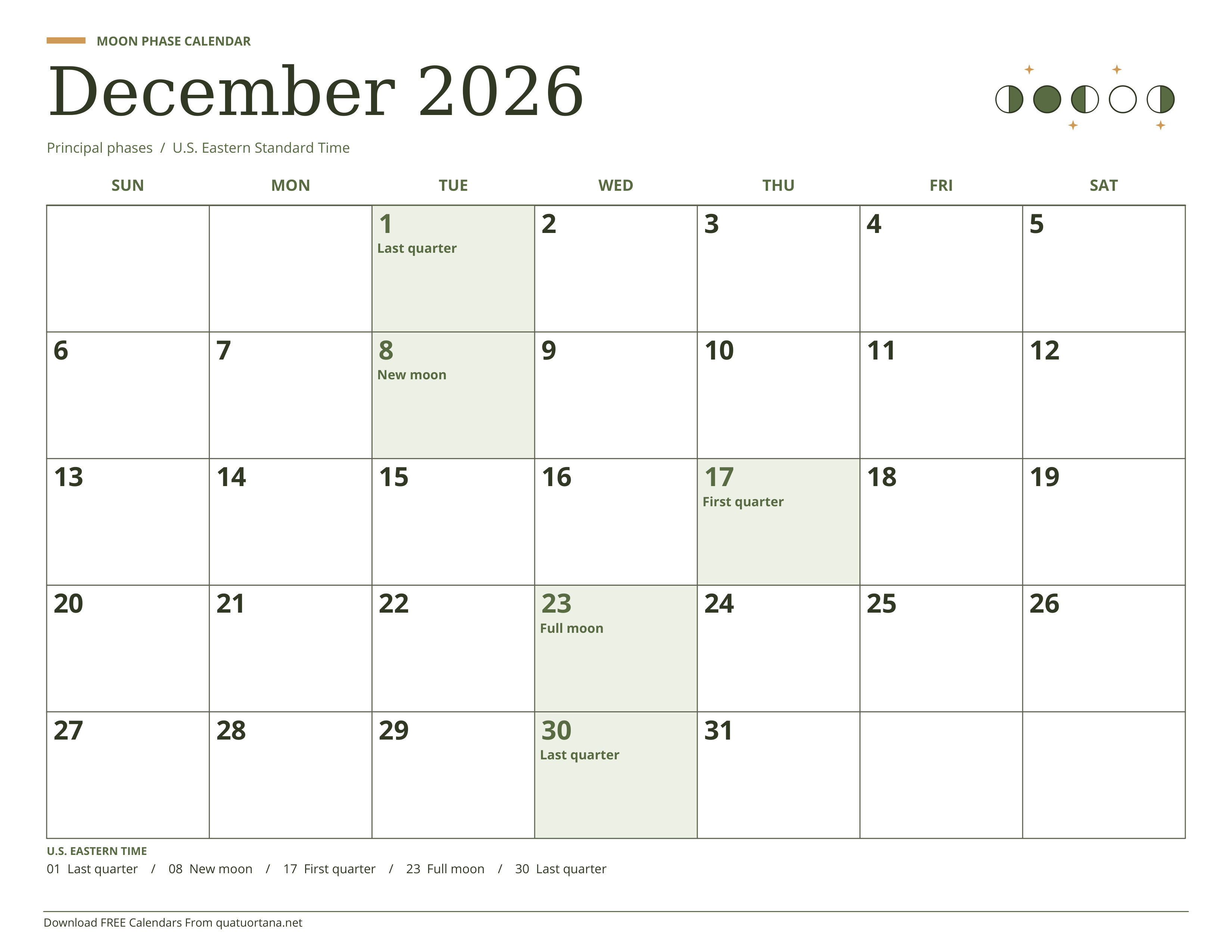
Download full-size JPG
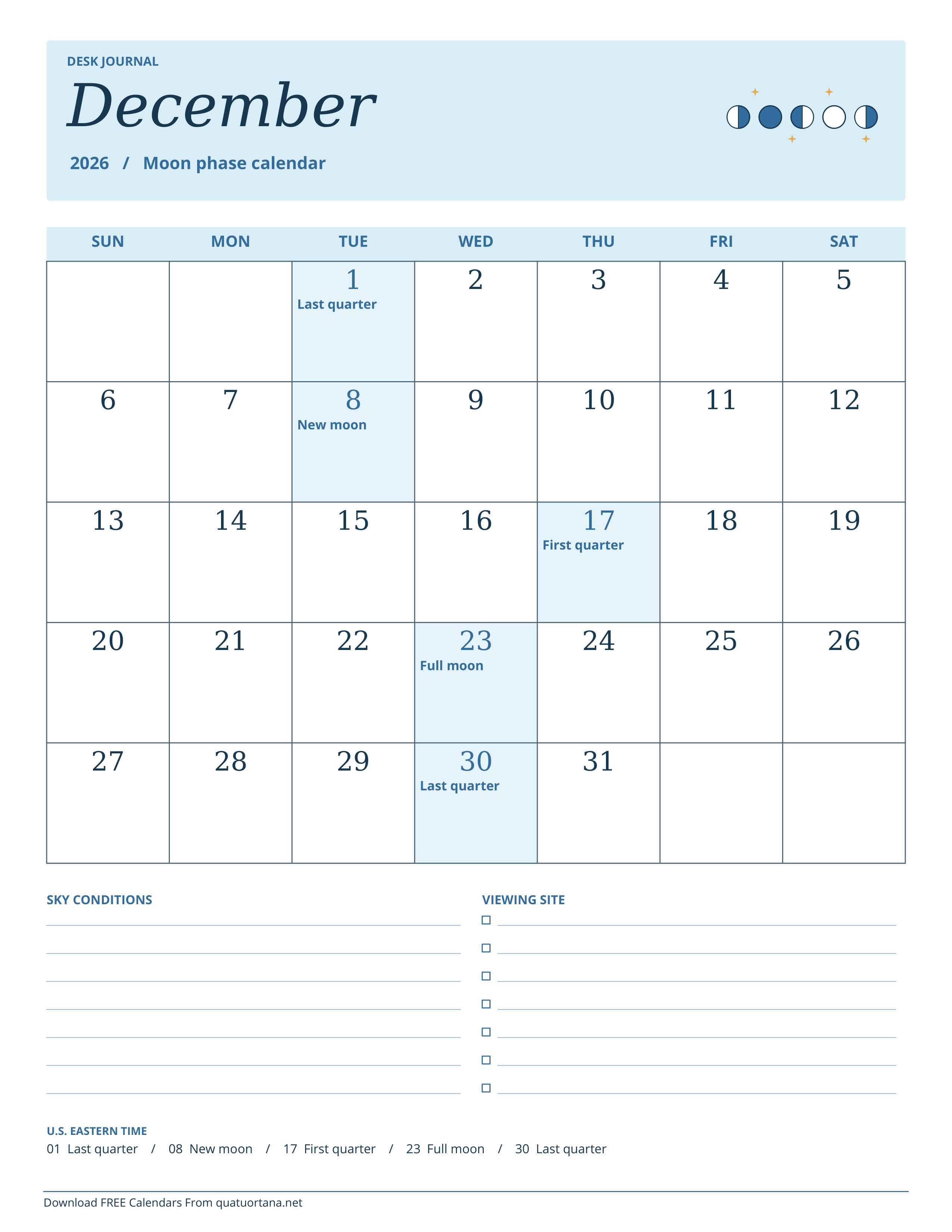
Download full-size JPG
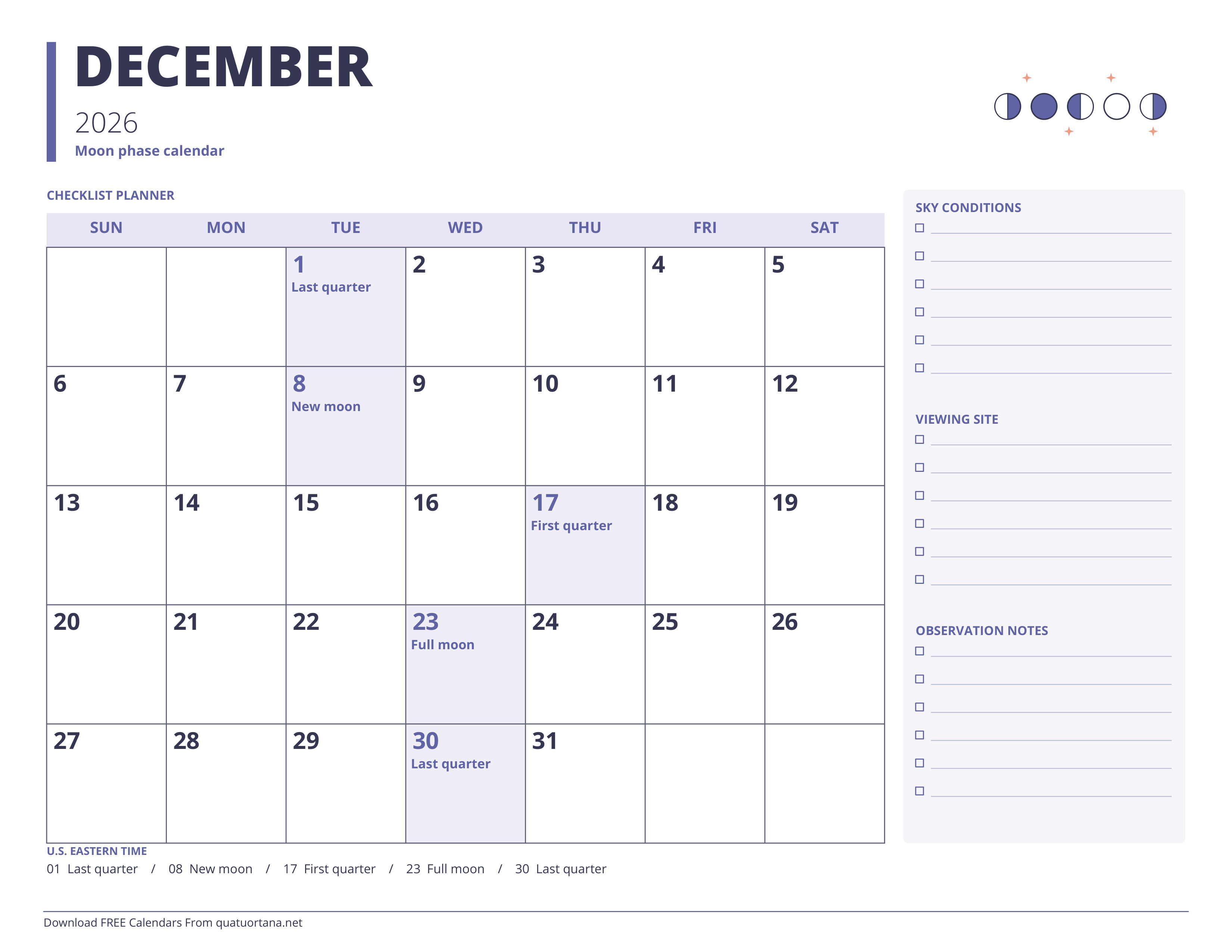
Download full-size JPG
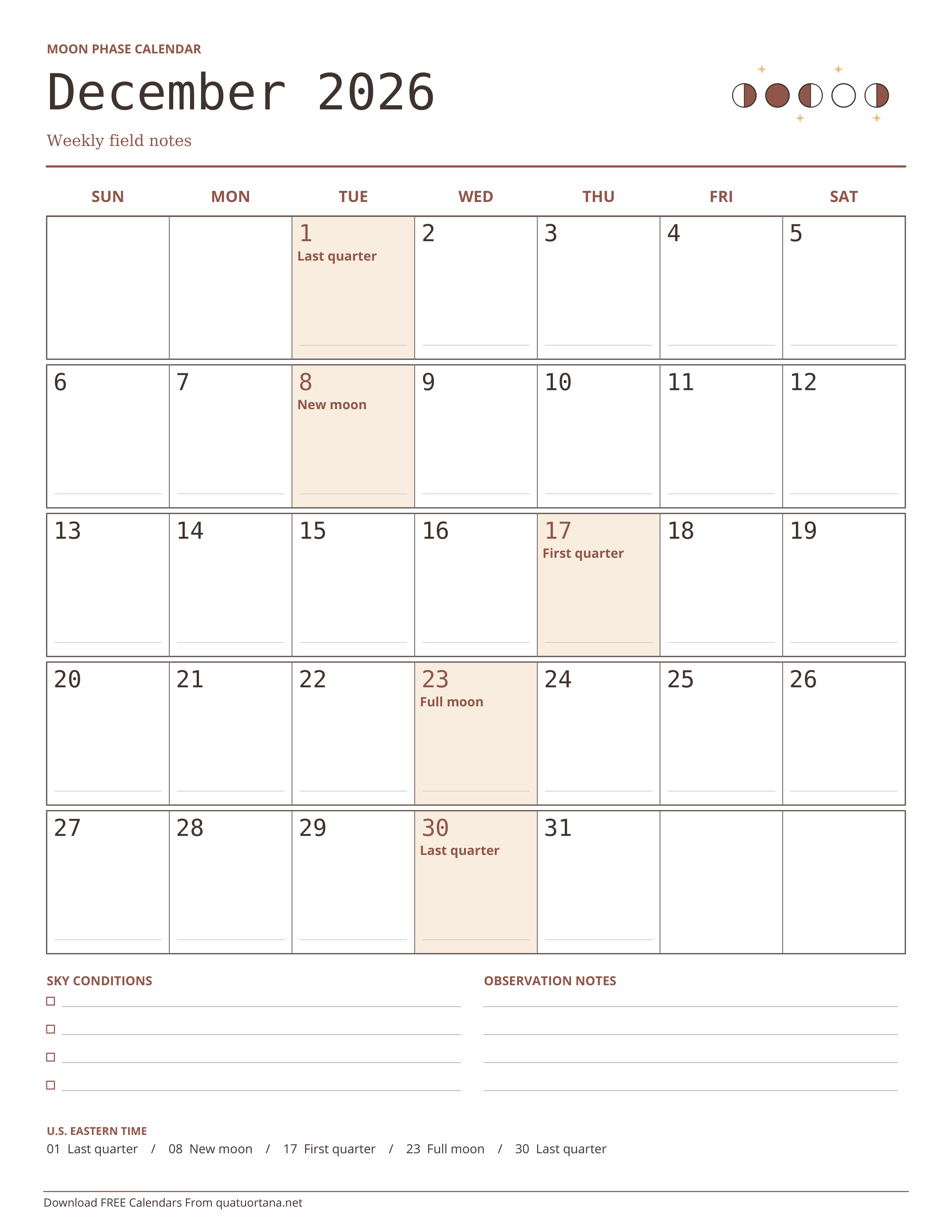
Download full-size JPG
December Moon Phase Dates and Times
| Phase | US Eastern Date | Eastern Standard Time | What to Look For Nearby |
|---|---|---|---|
| Last quarter | Tuesday, December 1 | 1:08 a.m. | A half-lit disk in the late-night or morning sky |
| New moon | Tuesday, December 8 | 7:52 p.m. | Dark skies when conditions and local lighting allow |
| First quarter | Thursday, December 17 | 12:42 a.m. | A half-lit Moon in the afternoon or evening |
| Full moon | Wednesday, December 23 | 8:28 p.m. | A nearly round disk on neighboring clear nights |
| Last quarter | Wednesday, December 30 | 1:59 p.m. | The return of a half-lit morning Moon |
The times above use the US Naval Observatory’s primary-phase data, converted from Universal Time by subtracting five hours. Each time identifies a particular moment in the lunar cycle. It says nothing about whether the Moon is above your horizon at that moment. To choose a time to go outside, use moonrise and moonset for your observing location. A building, tall tree, or ridge can delay your first clear view even after the published local rise time.
Why a Quarter Moon Looks Half Full
The names first quarter and last quarter refer to progress around the phase cycle. At either quarter, roughly half the disk facing Earth looks illuminated. Between new and full, the illuminated portion appears to grow, or wax. Between full and new, it shrinks, or wanes. On the paper calendar you can show the sequence with a few pencil sketches. Use the outline of a coin for the disk, then shade the area that appeared dark at the time you looked.
Read a December 2026 Calendar With Moon Phases Across Time Zones
A date conversion matters most near midnight. Take the first quarter on Thursday, December 17, at 12:42 a.m. Eastern. Subtract three hours for US Pacific Standard Time and you get 9:42 p.m. on Wednesday, December 16. The date changes. By comparison, the full moon at 8:28 p.m. Eastern on December 23 corresponds to 5:28 p.m. Pacific on the same day. Two dates on two calendars can therefore describe a single physical event accurately.
The first last quarter provides an extra wrinkle. At 1:08 a.m. Eastern on December 1, a clock on the US Pacific coast still reads 10:08 p.m. on November 30. Anyone using the printable in California can add a note in the margin for this one. Keep the time zone in the heading if you share a copy with friends elsewhere. Replacing the heading with a different zone while leaving the printed dates untouched can create a misleading record.
Make a Five-Minute Moon Journal
- Choose an observing spot where you can return easily and see a useful portion of the sky.
- Record the local date and time of each visit, including evenings when clouds hide everything.
- Sketch the visible shape or write a few words about it, such as “thin crescent low in the west.”
- Compare the sequence after several days. Look for the change in shape and position between observations.
A family can divide the work without needing a telescope. One person records the time, one sketches the Moon, and another notes the scene nearby. A phrase such as “above the roof peak from the back steps” is much more useful for repeating the observation than “up there.” Return to the same step. Moving to the other side of the house changes your view of the roof, even when the Moon has barely changed position.
Choose an Observing Night With the December 2026 Moon Phase Calendar
- For a drawing exercise, compare several evenings around first quarter. The dividing line between light and dark gives the eye a clear feature to follow.
- For a bright moonlit scene, look on a clear evening near December 23 and confirm the local moonrise first.
- For a look at fainter stars, consider evenings around the new moon and choose a spot away from strong artificial light.
- For the last quarter, try a morning observation on a suitable date and check the expected position before heading out.
If the sky is overcast at the exact instant of full moon, keep the next clear night on the schedule. The Moon changes appearance gradually enough that a comparison of two nearby nights can teach more than a single carefully timed photo. Label photographs with the time, location, and direction of view before comparing them. By December 30, you can trace a full set of changes across the page and see where weather or a busy evening interrupted your own observing record.
Related Calendars
Record sky conditions on a calendar with notes. The December dates guide gives you a broader list of days to mark alongside lunar events. For the full collection, visit the free printable December 2026 calendar.
1 thought on “December 2026 Calendar With Moon Phases: Free Printable”