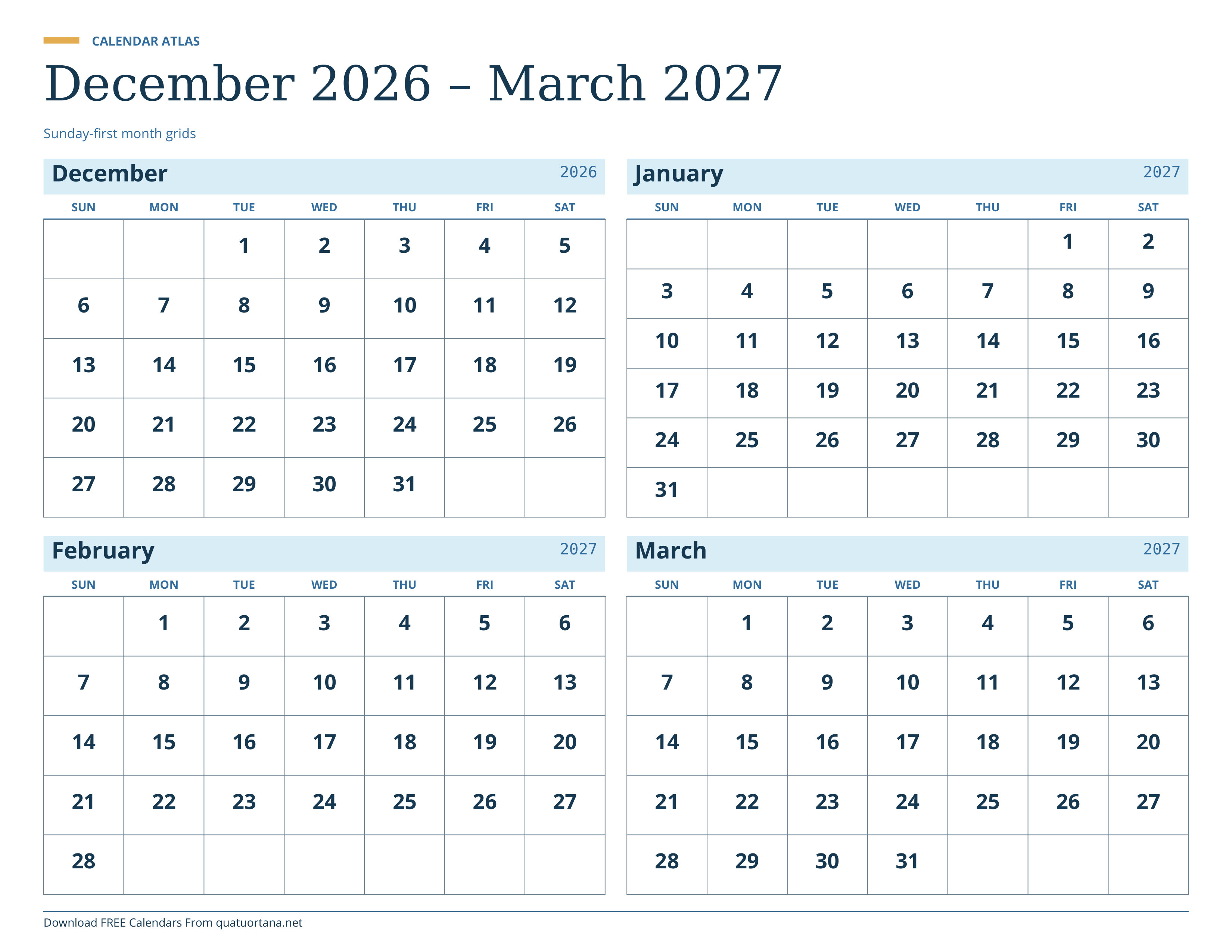
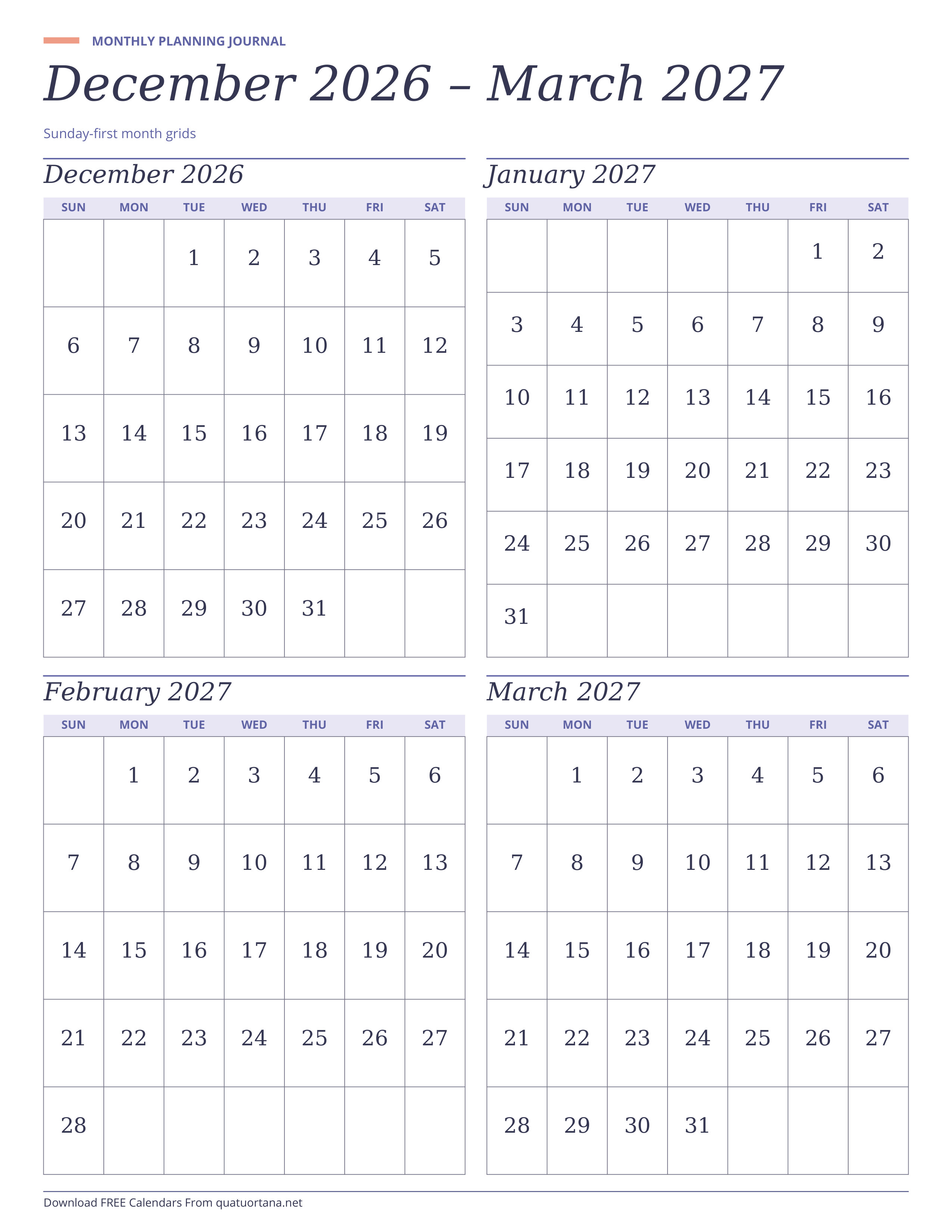
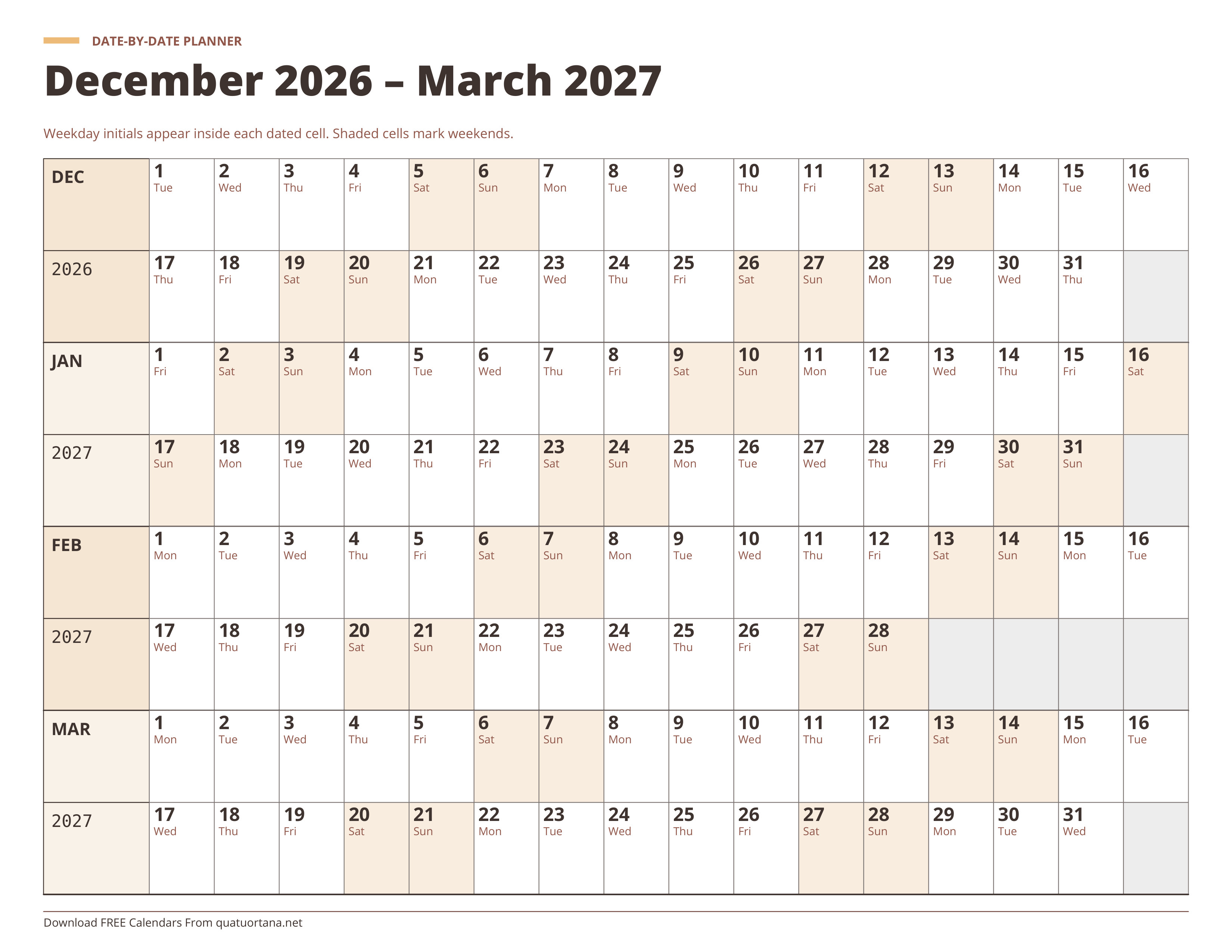
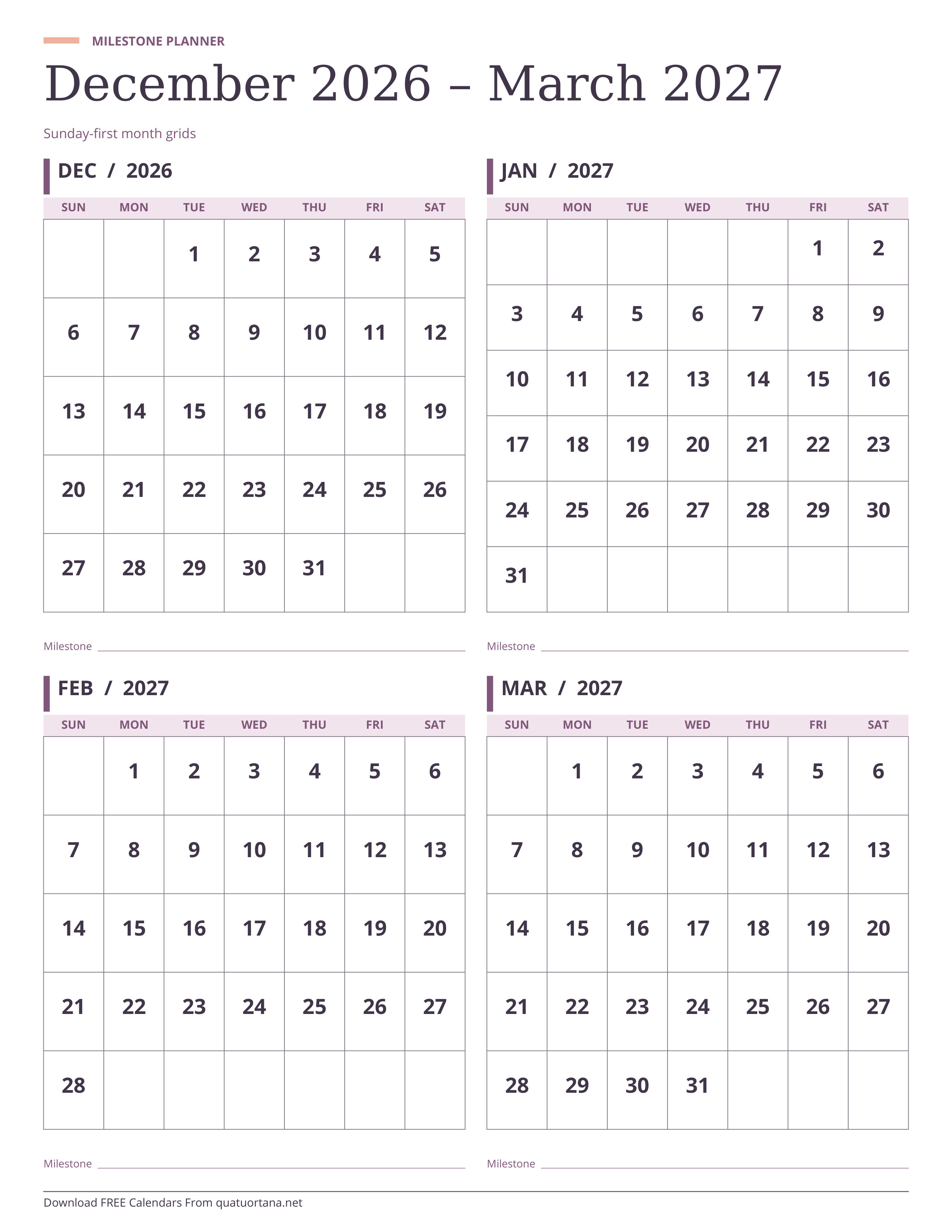
December 2026 to March 2027 Calendar joins the last month of 2026 to the first quarter of 2027. The printable starts Tuesday, December 1, and ends Wednesday, March 31, covering 121 dates across two years. It is a good fit for a winter project whose preparations start in December but whose main work takes place in spring. A seed-starting plan, for example, needs ordering, equipment checks, planting windows, and a clear handoff to the next season.
December 2026 to March 2027 Calendar: Four-Month Planner
Download full-size JPG
Download full-size JPG
Download full-size JPG
Download full-size JPG
Write the Year Beside Each Milestone
December 31 is a Thursday and January 1 is a Friday. A task moving back one day across that boundary also changes its year, something easy to overlook on a handwritten label or a digital reminder. Write “2026” on notes about December orders and “2027” beside the spring planting target. This keeps last season’s packet notes, photographs, and receipts from getting mixed into the new plan.
| Month | Date Range | Example Garden Task |
|---|---|---|
| December 2026 | Tuesday the 1st to Thursday the 31st | List what you own and what must arrive before planting |
| January 2027 | Friday the 1st to Sunday the 31st | Confirm orders, available shelf space, and a planting target |
| February 2027 | Monday the 1st to Sunday the 28th | Count backward from packet instructions and label trays |
| March 2027 | Monday the 1st to Wednesday the 31st | Check progress and arrange the next outdoor or indoor step |
Work Backward From Your Local Conditions
Winter means different growing conditions across the United States. A calendar date alone cannot tell a gardener when a particular plant can move outside. Begin with a date appropriate for the plant, your location, and the protection you can provide. Local growing guidance and the directions on your specific seed packet are better starting points than a generic national planting day. Use the printed dates to do the counting once you have those inputs.
Count Backward on a December 2026 to March 2027 Calendar
Suppose you have selected Saturday, March 27, 2027, as a tentative transplant date and your own packet calls for starting seeds indoors six weeks earlier. Count back six Saturdays. You land on Saturday, February 13. If the directions instead call for an eight-week lead, the starting date would be Saturday, January 30. A difference of only two weeks changes the month in which you need your trays and supplies ready.
- Write the intended outdoor date in pencil and add the plant name or a short code.
- Find the starting interval on the packet for that plant and count back the stated number of weeks.
- Place a separate reminder before the starting date to check seeds, labels, supplies, and space.
- Record the actual sowing date when it happens. Keep the original target visible if it explains why something changed.
Give Each Month a Job Beyond Buying Supplies
December is a useful month for measuring the space you will actually have. An empty shelf may hold several trays now, but larger seedlings may need more room later. Sketch the space in your notebook and put only the date of the check on the calendar. In January, compare what has arrived with the order and circle the first date that depends on a missing item. You can then tell whether a substitution is urgent.
February 2027 runs exactly four Monday-through-Sunday weeks. March begins on a Monday as well, so the two months share the same weekday for every date from the 1st to the 28th. This makes a regular Monday check easy to schedule, but it also makes it easy to write the correct number in the wrong month. Include the month on plant labels and on any note that will travel away from the calendar.
- Give trays short codes that match a planting notebook, leaving room in the date boxes for more than one variety.
- Mark dates someone else will handle routine care during travel and record how to reach that person.
- Keep expected and observed dates distinct so you can see how the plants actually developed.
- For a tray moving to a new location, enter the move date and label the destination in the notebook.
Allow the Spring Target to Change
Check conditions again as the outdoor date approaches. If the garden bed or weather is unsuitable, revise the outdoor date and look at what that means indoors. A delayed move can affect shelf space for the next group of seedlings. Circle the point where both groups would need the same space and decide whether to rearrange the shelf, start fewer trays, or move a later planting window.
Transfer Tasks From the December 2026 to March 2027 Calendar
March 31 falls on a Wednesday. Write down the next action for any plant or project still in progress, even if the date is in April or May. A northern gardener may use all four months for collecting supplies, learning the local timing, and starting a few early trays. Leaving the outdoor date beyond this calendar is perfectly workable when the next sheet carries the decision forward.
Keep the completed page with plant labels or photos from the season. Next winter you can compare intended dates with actual ones and see which delays mattered. A missed ordering day may have had little effect while a crowded shelf set several trays back. Those details turn a four-month planner into a practical record for the next time your winter preparations lead into spring.
Related Calendars
If the year-end handoff is your main concern, use the December–January holiday view. For the quarter that ends where this plan begins, see the Q4 2026 calendar. For the full collection, visit the free printable December 2026 calendar.