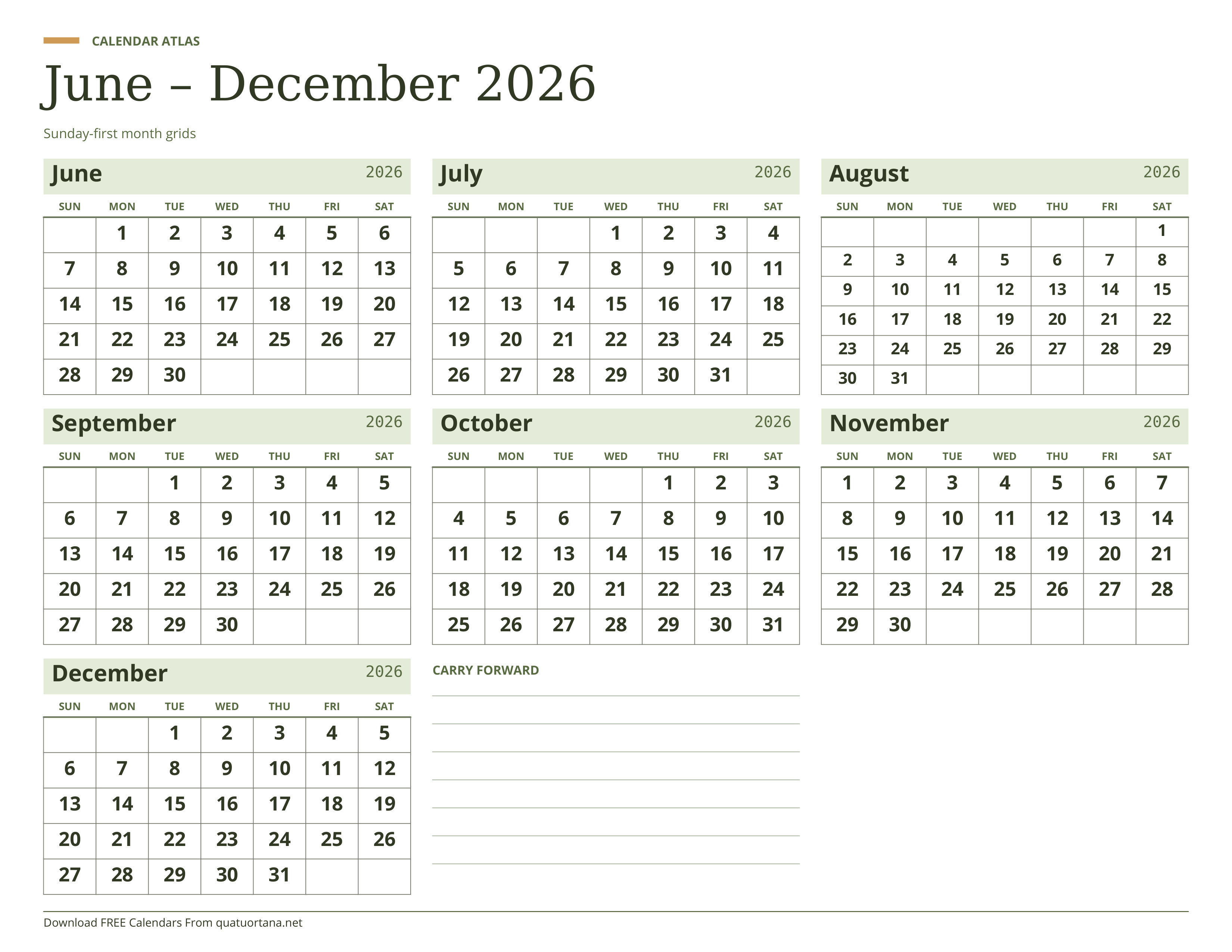
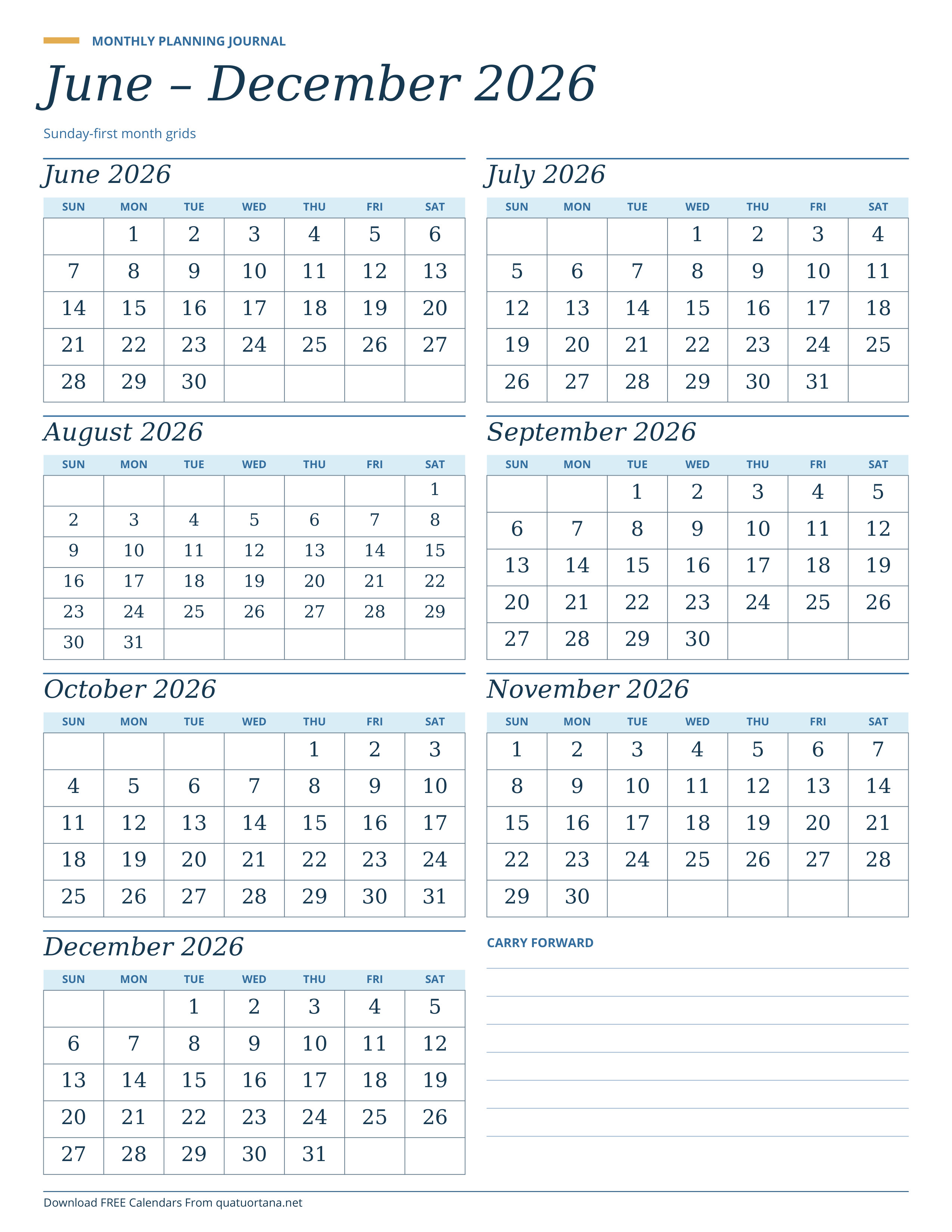
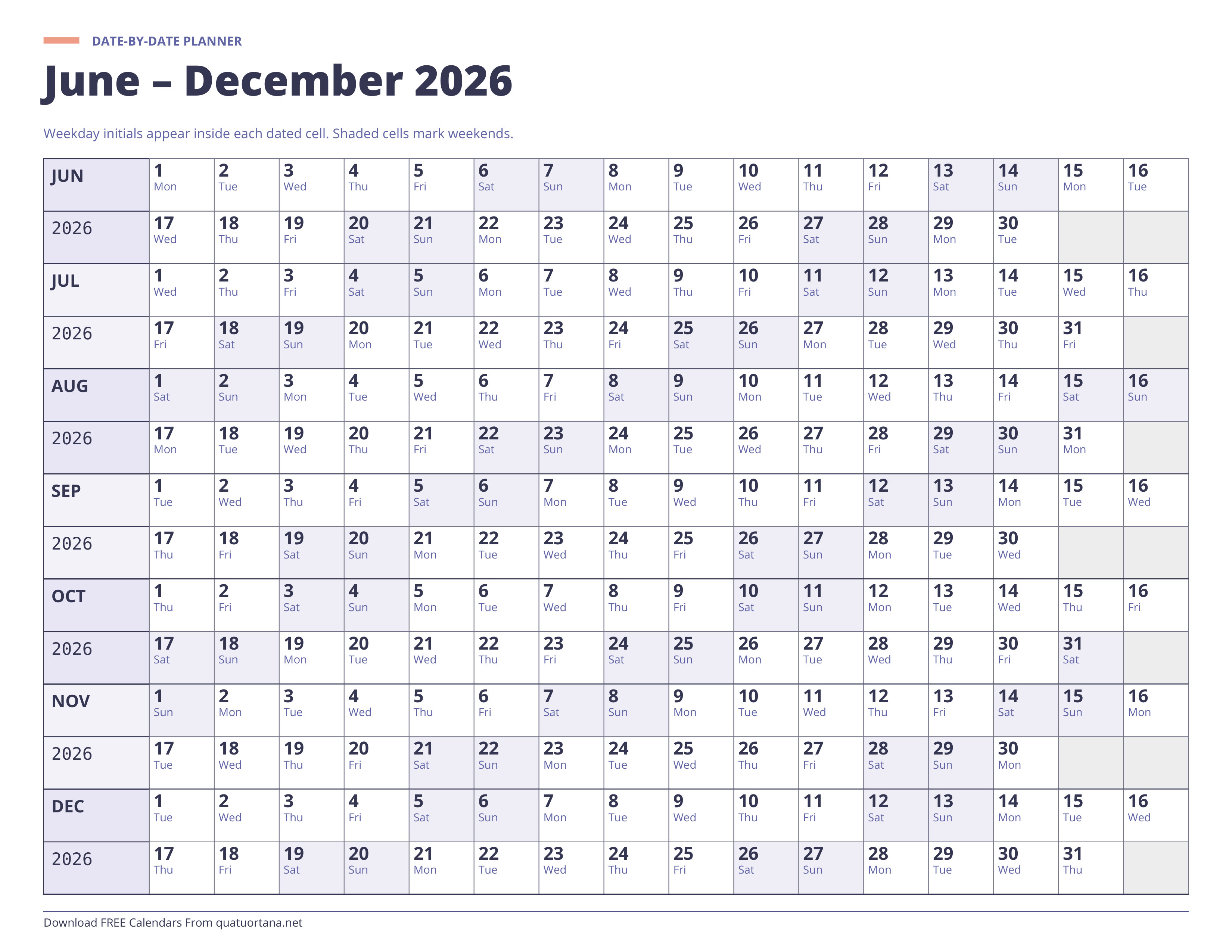
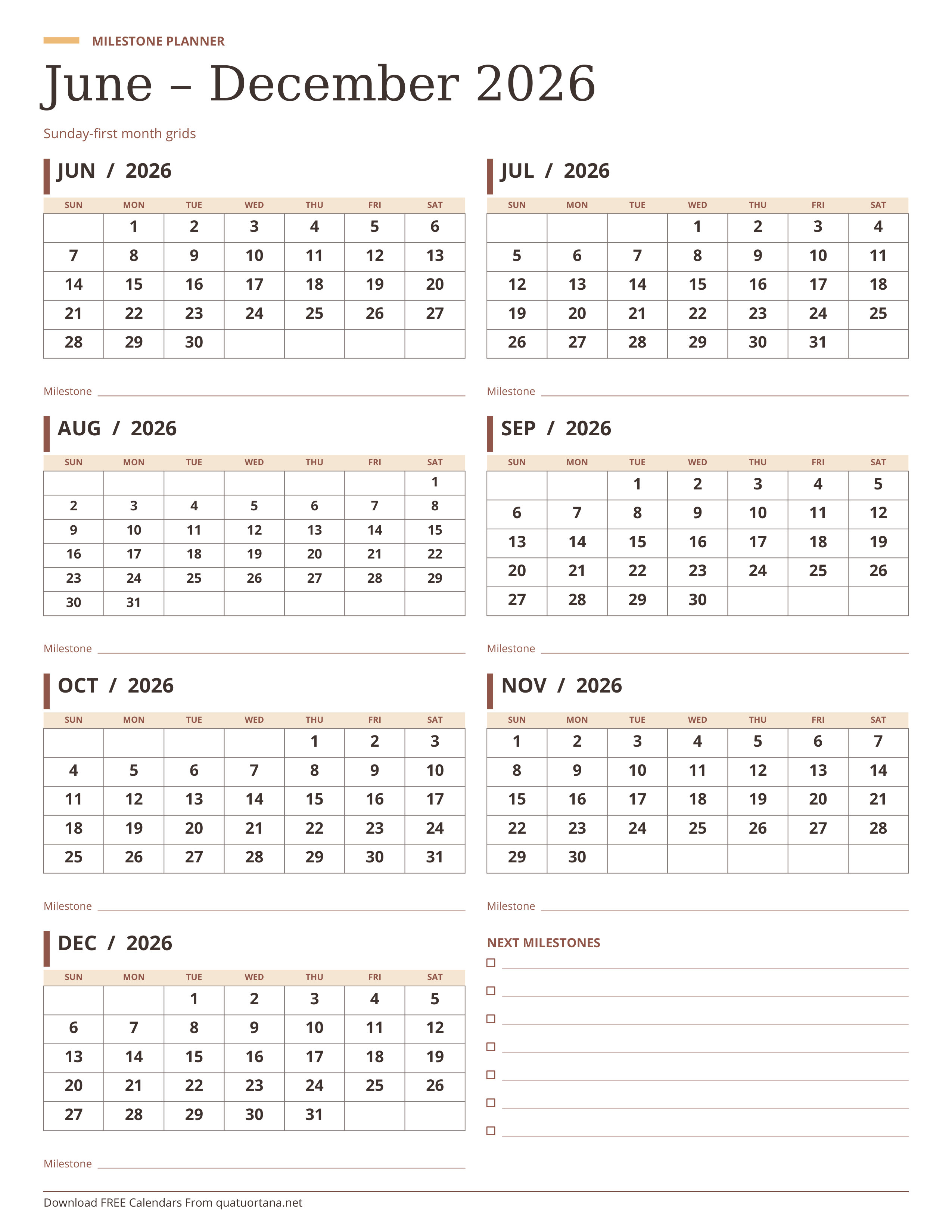
June to December 2026 Calendar starts on Monday, June 1, and finishes on Thursday, December 31. The seven months cover 214 dates. June gives you a full opening month before the second half of the year begins, a useful advantage if you need to recruit helpers, learn a routine, or arrange summer coverage before a program gets busy. The same sheet can carry those early promises all the way through a December handoff.
June to December 2026 Calendar: Seven-Month Planner
Download full-size JPG
Download full-size JPG
Download full-size JPG
Download full-size JPG
Use June as the Setup Month
Consider a neighborhood walking group that wants to meet monthly through December. The organizer needs more than a list of walks. Someone has to check the route, greet newcomers, make a decision if conditions change, and tell people whether the walk is going ahead. These jobs may belong to the same person in June and different people by November. A seven-month sheet shows when the organizer must train a second host.
June starts with a complete Monday-through-Sunday week and has five Mondays. The group could hold an initial walk on Sunday, June 21, then use the rest of the month to settle its routine. An early tryout gives prospective hosts a chance to experience the job before adding their names to half a year of dates. Record the actual time needed for setup and cleanup as well as the walk itself.
Check Meeting Dates on a June to December 2026 Calendar
| Month | Third Sunday | One Decision to Confirm |
|---|---|---|
| June | June 21 | Agree on an identifiable meeting point |
| July | July 19 | Check that a host will be in town |
| August | August 16 | Arrange coverage for a summer absence |
| September | September 20 | Let a new host lead with support |
| October | October 18 | Check the route at the proposed meeting time |
| November | November 15 | Confirm seasonal access to the meeting place |
| December | December 20 | Announce the final date and any follow-up |
These are example dates, so move any session that conflicts with the venue or the people involved. A group with a regular Sunday meeting still needs a workable plan for notifying someone who attends only occasionally. Put the decision deadline on the calendar before the walk. If the host makes the call on Saturday evening, a volunteer should know who can update the announcement that night.
Introduce a New Host Before the Old One Leaves
Suppose the founding organizer is free through September but moves out of the neighborhood in October. A handoff dated September 30 would leave the replacement no chance to lead alongside the founder. Give the incoming host the September 20 session and put the outgoing organizer in a supporting role. Afterward, the two can walk through any surprise while it is still easy to reconstruct.
- Mark the outgoing volunteer’s final available date and the incoming volunteer’s first available date.
- Find one session both can attend and agree who will lead it.
- Pick a date to exchange the route notes, contact method, and any supplies.
- Schedule a short check after the first independent session so a fix can be made before the next month.
Notice When a Summer Arrangement Expires
A summer meeting spot can become inconvenient when the park entrance changes hours or a set of restrooms closes for the season. Look for the actual notice and enter its effective date. For evening programs, check lighting and access at the planned meeting time. A sunny midday visit tells the organizer very little about whether a newcomer will find a sign or recognize an entrance later in the day.
- Keep a second meeting point in the route notes and record who can authorize a change.
- Use one date for checking seasonal opening hours and another for announcing an adjustment.
- Ask a volunteer unfamiliar with the route to follow the instructions before sending them to the group.
- Mark which supplies, keys, or signs belong to the venue so someone can return them at the close.
Revise a June to December 2026 Calendar After a Missed Meeting
If the August host withdraws, you can shorten the walk, substitute another host, or cancel one meeting. Keep the later months visible while choosing. Moving August’s event to the weekend of September 12 may leave the leaders with back-to-back sessions and nobody free to prepare the September 20 route. A clearly communicated gap can be easier to manage than moving every later date by one week.
Record the Piece You Want to Carry Forward
At the December session, decide whether the group ends here, resumes after a break, or changes hands. Each choice leads to a different calendar entry. Ending calls for returning equipment and closing announcements. A break needs a date when members will hear from the group again. A handoff needs a named person and an agreed time for passing on the records.
Keep the finished page with your route notes. Someone starting next June can see how much setup the first walk required, when the summer host had to step back, and which autumn meeting needed a different location. If you use the sheet for another volunteer project, record when the job began, who was responsible at each change, and what remained to be done by the last day.
Related Calendars
For a May kickoff, open the May–December calendar. If the project runs for exactly the second half of the year, try the July–December calendar. For the full collection, visit the free printable December 2026 calendar.